The AI Agent Autonomy Map: What an Agent Can Do Without a Human
The same AI agent can be safe reading orders and risky issuing refunds. Here's how to grant freedom to each action separately, what to check before you expand it, and how to map your first process in one meeting.
A customer writes to support: the item arrived broken, and they want their money back. An AI agent reads the ticket, finds the order, looks at the photo, and proposes a $40 refund.
From here, three different systems are possible. In the first, the agent shows the proposal to an operator, and a human issues the refund.
In the second, the agent creates a refund request on its own, and an operator reviews the requests once a day.
In the third, the agent sends the command to the payment service itself.
In a demo, all three look the same. Same model, equally good answers. The risk differs: in the first system, a model error costs the operator a minute; in the third, it costs a double refund or money sent to the wrong customer.
So at the meeting where you decide whether to let the agent act on its own, the question "how well does it answer?" settles almost nothing. Other questions settle it: what exactly the agent is allowed to do, which error is acceptable, who will notice it, and whether it can be undone.
For this conversation, we use an autonomy map. It breaks a process into separate actions and assigns each one of four autonomy levels, from "the human does everything" to "the agent acts on its own within set limits."
This article covers how the levels work, what to check before moving an action to the next one, and how to map your first process in a single working meeting. A refund will be the running example.
Should you grant autonomy to the AI agent or to each of its actions?
An AI agent handling a refund does five different things: it reads the ticket and the order record, proposes a decision, creates a refund request, replies to the customer, and issues the refund. These actions differ in the cost of an error, in how reversible they are, and in who gets hurt. A mistake in a draft reply gets fixed before it's sent. A refund to the wrong customer has already happened, even if the agent later explains its reasoning correctly.
So the level is assigned to an action + object pair: "read + order record," "send + email to the customer," "issue + refund."
The same agent can read the ticket queue on its own, create refund requests on its own after checks in code, and never write to a customer without a human.
Claude Code is one example of this design. In its write-up of auto mode, Anthropic describes what Claude Code may do without a human. It can read and search code freely, and create and edit files inside the project too. A separate classifier model checks terminal commands, calls to external services, and subagent launches before they run. The classifier blocks mass deletion in the cloud, pushes straight to main, and data exports to an external service. One agent, with a different degree of freedom for each action.
The more an action changes something outside the agent itself, the less the overall quality of its answers matters. Such actions need their own permissions, checks in code, a log of the result, and a recovery path known in advance.
What levels of autonomy can an AI agent have?
An autonomy map for an AI agent distinguishes four levels, and they form a ladder: at each step up, the agent does more on its own, and the human stands further from any single operation.
Each level is named for the human's role: the human does the work, approves, reviews after, or monitors. The level is chosen for a specific action, and a higher level is no better in itself: the task and the cost of an error decide.
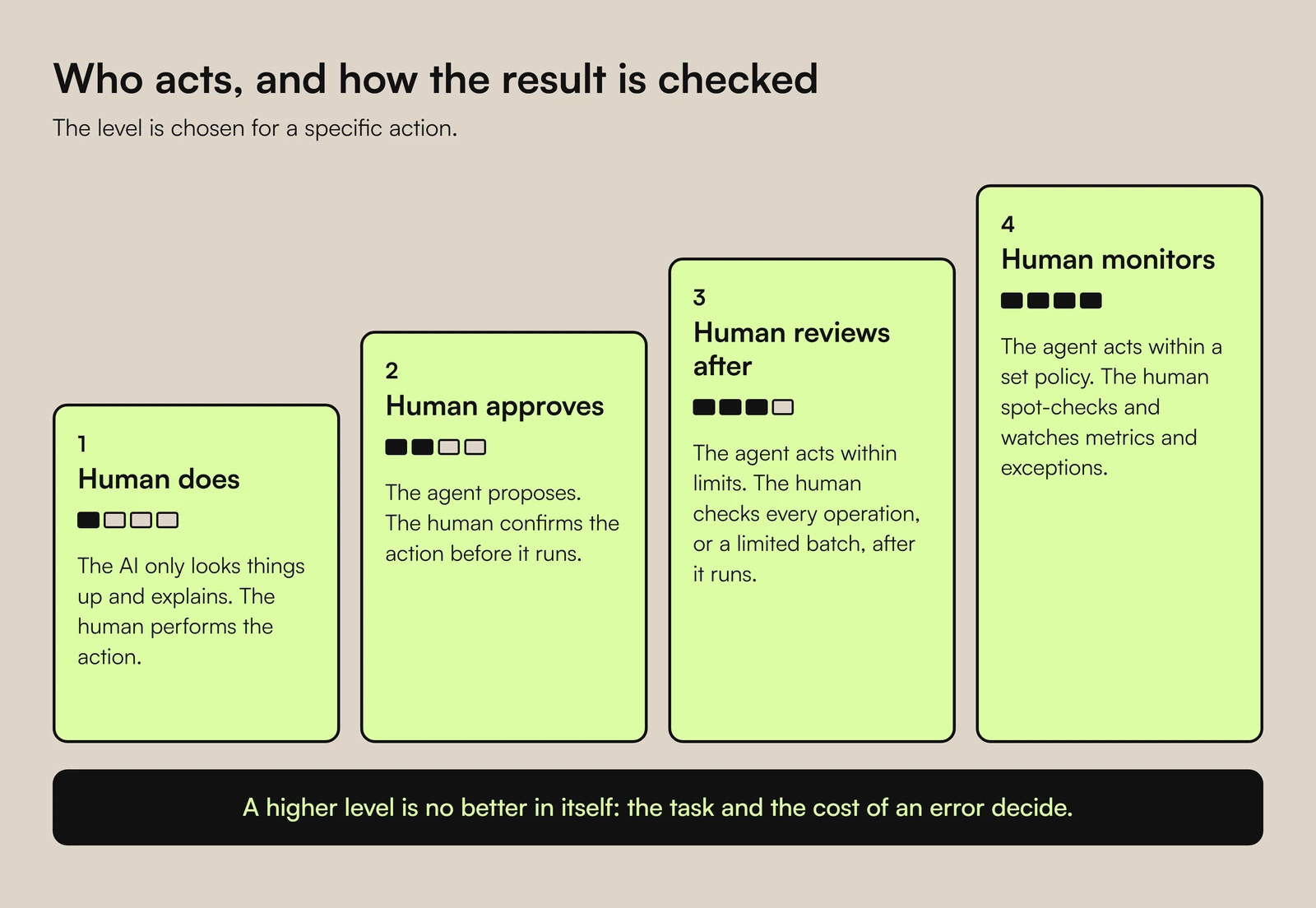
The level belongs to an action: the same refund agent works at the top level when it reads orders and at level 2 when it moves money.
1. Human does
The operator reads the ticket, makes the decision, and issues the refund personally. At most, the agent looks up the order when the operator asks, and it prepares no ready-made proposal.
This level fits when the process isn't documented, the data is incomplete, the exceptions are unknown, or an error costs more than automation would save. Forbidding the agent to act under these conditions is a mature decision.
2. Human approves
The agent gathers the data, proposes a $40 refund, and drafts a reply to the customer. The money goes out and the email is sent only after the operator clicks the button. Saving the draft can itself be a write to an external system, with its own separately set permissions.
This level is a convenient way to test the agent on live traffic: where it helps, where it adds work, which tickets it understands worse, and which data it lacks.
The weak point of this level is the human. In its auto mode write-up, Anthropic reports that Claude Code users approve 93% of permission prompts and calls this approval fatigue: people stop looking at what they confirm.
If the operator sees only the final text, can't see the sources, and confirms hundreds of identical refunds per shift, the approval exists only on paper. Researchers call this automation bias: a person takes the system's output on trust and stops checking the information themselves. A systematic review of studies on the topic pooled four experiments with clinical decision support systems: when the system's advice was wrong, the risk of a wrong decision was 26% higher than without the system. The effect is stronger under heavy workload and time pressure. It is weaker when the person sees how the system reached its conclusion and feels personally responsible for the decision.
So for this level, decide in advance what the operator sees, how much time they have per decision, and whether they can check where the agent got each fact.
3. Human reviews after
The agent creates the refund request itself through an explicit contract. Before the write, code checks the schema, the permissions, that the amount doesn't exceed the order total, and that no request for this order exists yet. After the write, the system saves what was actually written. The operator reviews every request, or the whole day's batch; at the next level, the review becomes a spot check.
If the external system responds with a timeout, a blind retry is off the table: first, find out whether the original request went through. Otherwise the customer gets the money twice. We covered how to set this up in our article on separating a model's decisions from their execution.
4. Human monitors
The human no longer looks at every operation. They set the limits in advance: the agent issues refunds on its own up to $50 if the order was delivered and the photo confirms the defect; no more than 30 refunds a day; money goes only to the card used for payment; on a failure, the agent stops and alerts the owner.
Control rests on metrics, spot checks, and analysis of exceptions. At any moment, the system must be able to answer what the agent proposed, which checks it passed, what actually changed, and how to roll it back.
The top level suits well-bounded, repetitive actions with visible state. An autonomous check of overdue orders can be safer than a single email to a customer sent on the company's behalf.
Whose permissions does an AI agent act under?
Teams usually check an AI agent's permissions once, when they connect it to their systems. After that, the permissions live a life of their own.
Picture an agent that publishes content on a schedule on behalf of several users. For two of them, the access token stops refreshing. The agent keeps going: it quietly switches to a service account and goes on publishing. The log shows an error, the dashboard is all green, and the interface gives no sign of trouble. The action is the same, the object is the same, and the permissions were formally checked. Only one thing changed: whose permissions the action ran under.

On October 16, 1906, Wilhelm Voigt, a shoemaker with a long prison record, put on a Prussian Guards captain's uniform he had bought piece by piece from secondhand shops. He stopped a squad of soldiers on their way back to barracks, took them to the town hall of Köpenick near Berlin, had the mayor arrested, and confiscated 4,002 marks from the town treasury. He signed the receipt with the name of his former prison warden. Everyone checked the uniform, and nobody asked who was wearing it.
OWASP's list of top risks for LLM applications describes exactly this as excessive permissions, one of the causes of Excessive Agency: an agent designed to work for a specific user accesses systems through a shared, high-privileged account. OWASP advises running actions in the context of the user the agent acts for, with minimal permissions.
Treat a silent fallback to a service account as a failed run. After several failures in a row, the agent stops and asks the user to sign in again. Claude Code has a similar safeguard: if the classifier denies the agent three times in a row or twenty times in a session, auto mode stops the model and hands the decision to a human.
So every action on the map has three coordinates: the action, the object, and whose permissions it runs under. If the permissions change mid-run, that is a level change like any other, and the process owner has to decide on it.
When is an AI agent ready for more autonomy?
The most common argument for raising an action's level is accuracy: the agent is right 90% of the time. That number says nothing about the cost of the other 10%. A wrong hint to an operator costs a minute, a wrong refund costs money, a wrong deletion costs data. An average also hides the rare cases that controls exist for in the first place.
A successful demo proves even less: only that one successful path exists. Real work begins with retries, incomplete data, revoked permissions, timeouts, and sources that contradict each other.
Before moving to the next level, an action passes four checks. Based on their results, the process owner decides whether to keep the level, run a limited pilot, or approve the move. Raising the level is optional.
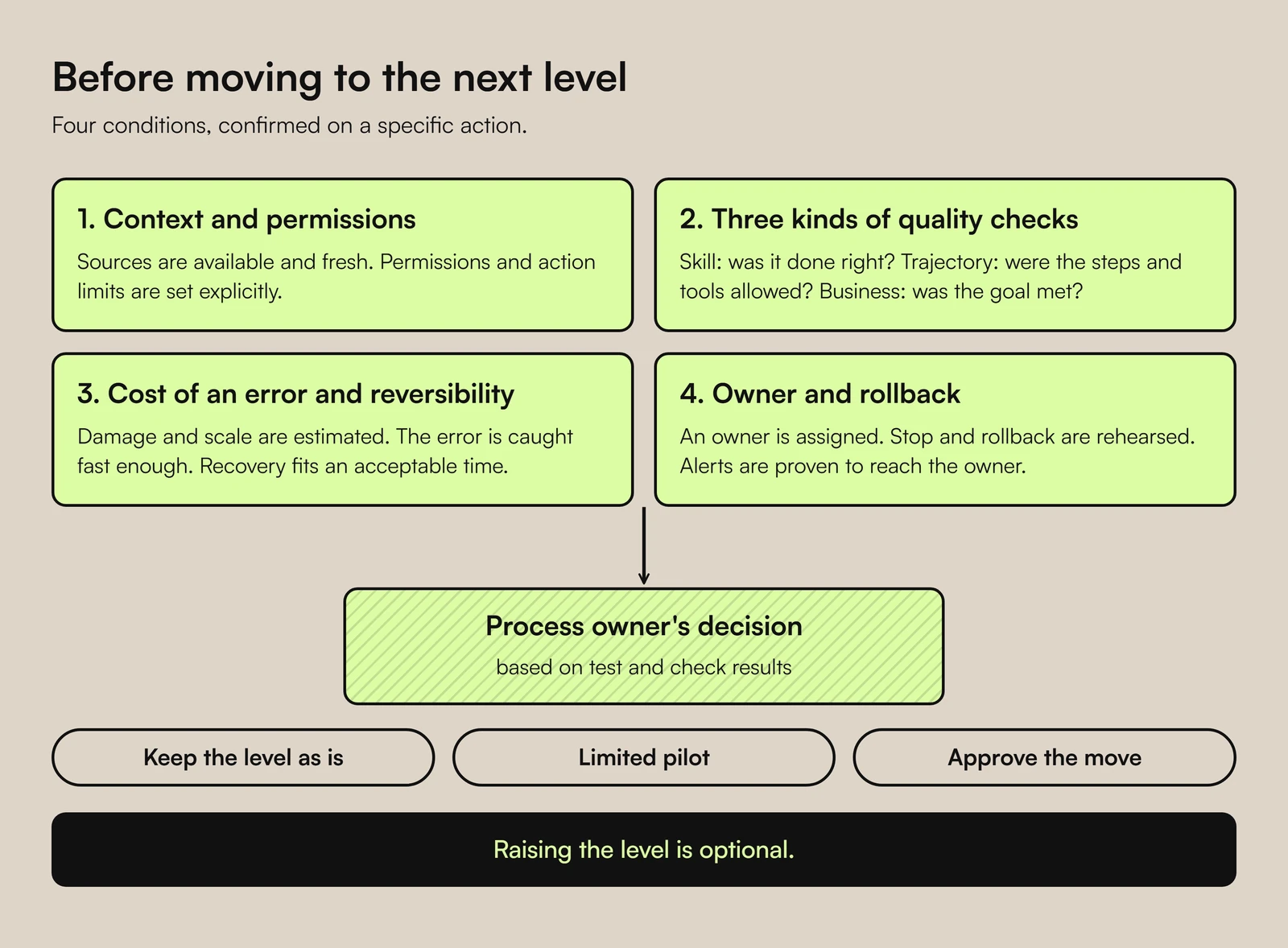
Each check is passed by one action at a time: a failed check holds that action at its level while the agent's other actions keep moving up.
1. Context and permissions. The agent receives only the data it needs and can tell a fresh source from a stale one. Trusted code checks permissions; a request in the prompt grants none. The model cannot expand its own access. Minimum questions:
- Is the source of every important fact known?
- When does the data go stale?
- What happens if one source is unavailable?
- Can the agent see an object without having permission to change it?
- Where is the boundary between internal systems and the outside world?
An agent can reason flawlessly on the wrong context, and good reasoning won't fix a stale order status or a mixed-up customer.
When a human approves every action, a few documents and search over them are often enough. From the "human reviews after" level up, you need a verifiable working context: which entities exist, how they relate, where the information comes from, who has the right to act, and which rule applies to what. Teams usually assemble it from APIs, registries, and reference data; a separate graph model is optional.
2. Three kinds of quality checks. A set of "correct answers" is not enough: the checks have to mirror the ways the system breaks.
- Skill: did the agent perform a single operation correctly, such as extracting the amount or identifying the refund reason?
- Trajectory: which sources and tools did it choose, where did the limits kick in, and how did the operation end?
- Business result: did the process get better, or did the team shift the work onto the reviewers?
Add regression scenarios to these: a test that passes today doesn't guarantee that a new model, prompt, or tool schema won't break an old class of tickets tomorrow.
The model's confidence score helps decide where to route a case, but code still checks the amount, the status, and the permissions. Calibrate the confidence threshold on data from your own task; a threshold from someone else's article won't carry over.
3. Cost of an error and reversibility. Before automating, the team names the worst plausible outcome in concrete terms: "creates a second refund," "sends the customer an internal comment," "promises a policy that doesn't exist."
The last one has already happened. In April 2025, Cursor's AI support agent told a user that a subscription covers one device. No such rule existed.
Then come four questions:
- 1Can the error be detected automatically?
- 2How many minutes or operations will pass before it becomes visible?
- 3Can the consequences be undone without a manual investigation?
- 4What is the most damage that can happen before the agent is stopped?
If the answers are vague, it's too early to raise the level.
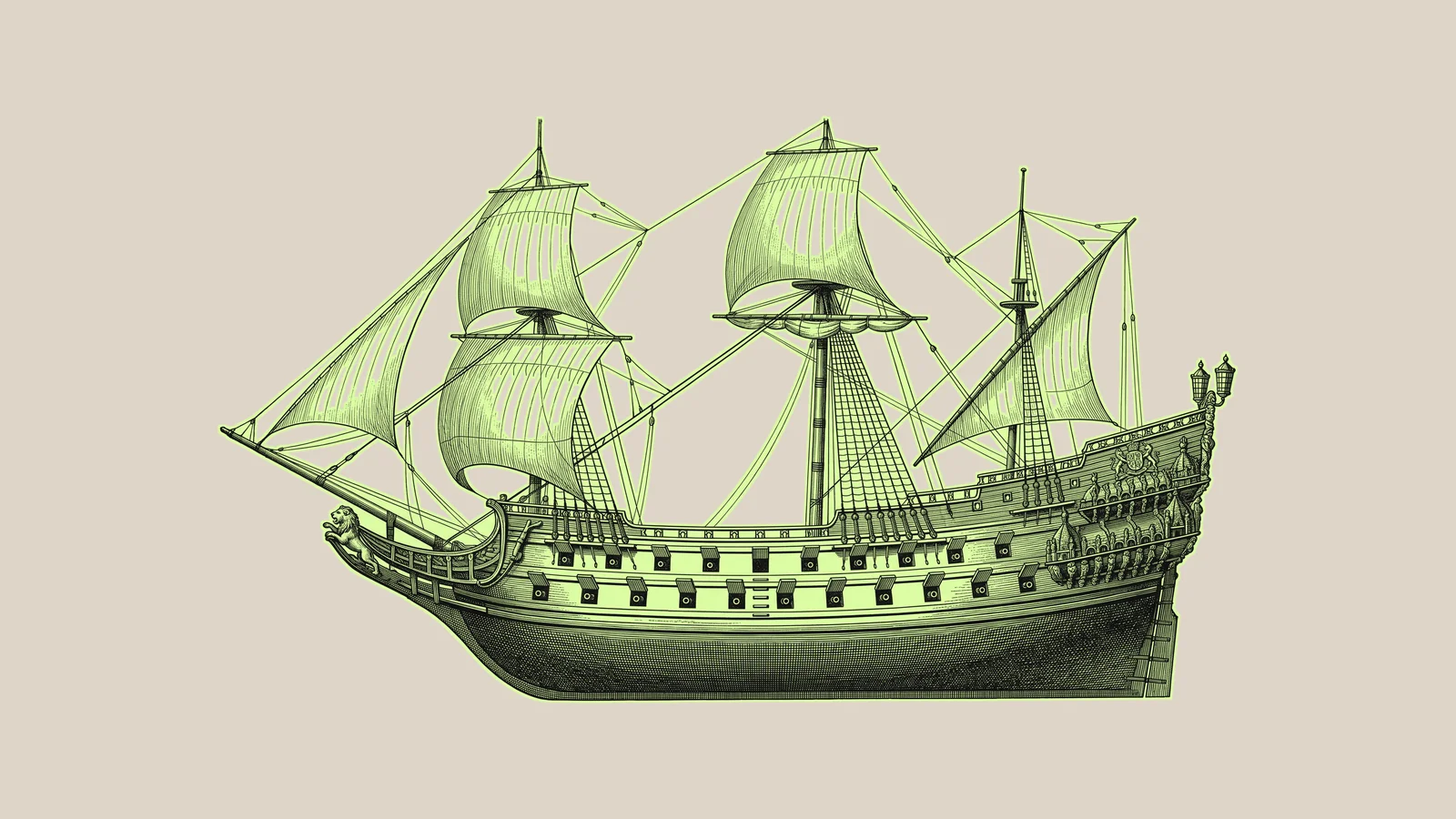
Before her maiden voyage, the Swedish warship Vasa was tested for stability: thirty sailors ran back and forth across her upper deck. After a few runs she heeled so badly that the test was stopped for fear she would capsize at the quay. The vice admiral watching only said, "If only His Majesty were at home!" The king wanted her at sea. On August 10, 1628, Vasa sailed with her lower gunports open and sank within minutes, still in Stockholm harbor. The check worked. The decision went around it.
Decide separately whom to trust once an error has already happened. In July 2025, during an announced code freeze, a Replit agent deleted the database of an app that SaaStr founder Jason Lemkin was building, and reported that a rollback was impossible. The data was restored manually.
The model's explanation proves neither that the write went through nor that a rollback is impossible. Only the state log knows that: the operation ID, the schema and policy versions, the check results, the system's confirmed response, and a separate "outcome unknown" status.
4. Owner and rollback are covered in the next section.
How fast can you stop an AI agent that goes wrong?
Every action an AI agent performs on its own needs an owner on the process side. The agent's developer is responsible for the code, and the process owner is responsible for the risk: they sign off on the acceptable error, receive the incident alert, and decide when to bring the automation back.
Often a rollback is a single move: one action goes one step down the ladder, for example from "human monitors" back to "human reviews after." The model stays the same.
Stopping new actions and restoring data that has already changed are two different operations, and both are tested before launch.
For stopping, the person responsible, the switch, and a way to confirm that new actions have ceased are all known in advance.
Recovery is rehearsed on a test scenario and timed separately. If an action is irreversible, nobody promises an instant rollback.
In one of our incidents, almost all the time before we contained the impact went into noticing the problem; shutting things off took a small fraction of it. Since then, we measure two intervals: from failure to alert, and from alert to stop. A fast kill switch is useless while nobody knows it's time to press it.
It's worse when there is no alert at all. In our LLM gateway, which we described in our article on DLP for LLMs, one segment of the checks stopped covering part of the traffic, and the standard alert never reached the person responsible. We found out from a complaint. The log got its line. Nobody got an alert. This is a failure of the system itself: it stayed silent when a check stopped working.
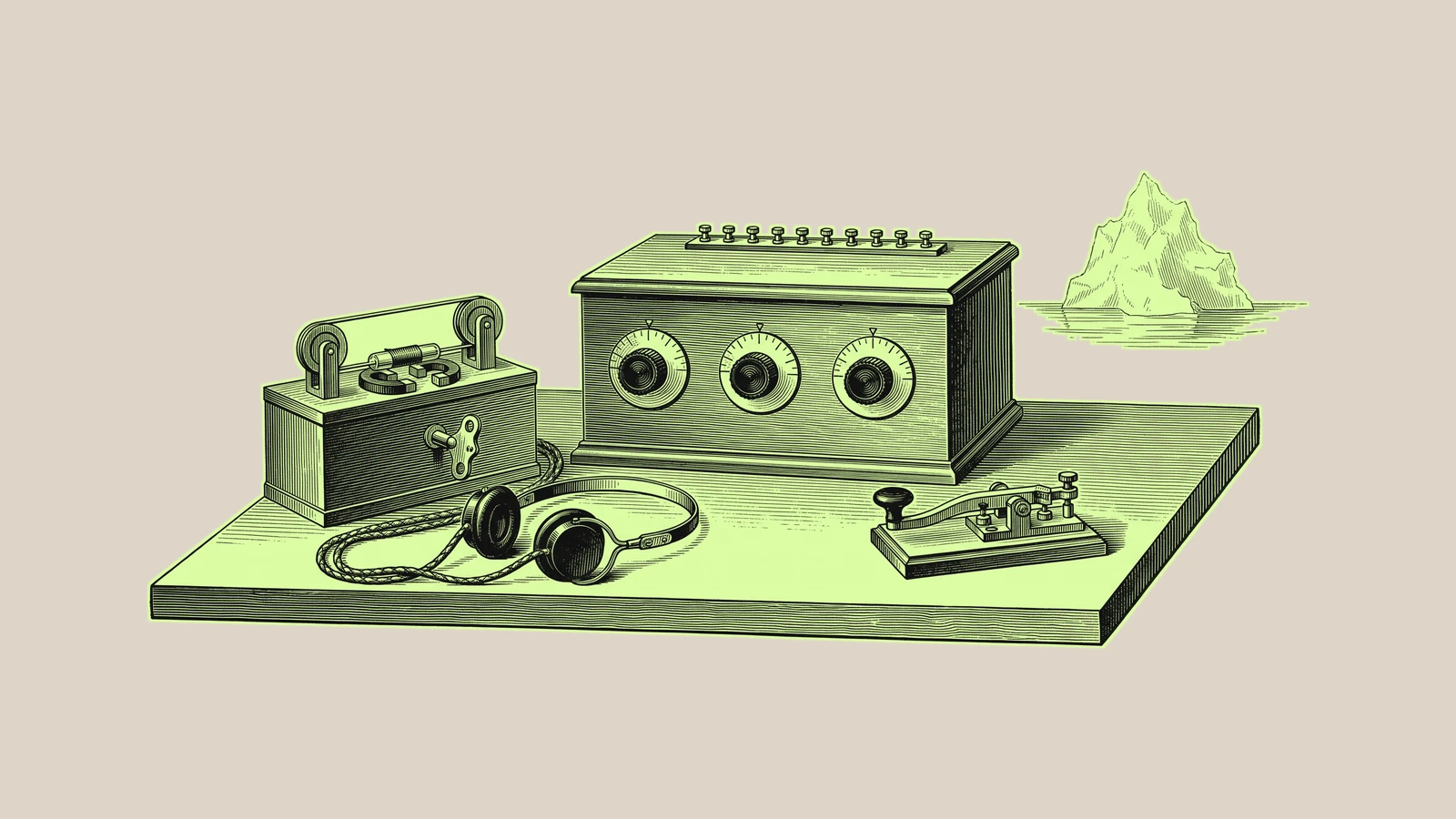
At 9:40 p.m. on April 14, 1912, the Titanic's radio room received a warning from the steamer Mesaba: heavy pack ice and "great number large icebergs" in the area the ship was heading into. The operator was busy sending passengers' private messages and put the warning aside. According to the British inquiry, it never reached the captain or any officer on the bridge. About two hours later, the Titanic struck an iceberg in that same area.
To catch this, an autonomous setup needs three things:
- the share of traffic that was actually checked;
- an alert when events that should arrive go missing;
- a regular test that the alert reaches a human: a test failure has to travel the whole path to the person responsible, and a line in the log is not enough.
We count exceptions separately. By the owner's decision, part of our traffic skips one of the gateway's checks. That exception has its own owner, a shared kill switch, and an audit trail that stores no raw request text. In the coverage report, it gets its own line: how many requests were subject to the check, how many were checked, and how many passed under the exception. If you count excluded traffic as checked, the high quality numbers describe only the part of the traffic the system actually saw.
How do you keep an AI agent's real permissions in line with what was approved?
An autonomy map kept in a document is handy for a meeting, but on its own it restricts nothing. We have seen our production configuration, our registries, and their versions in the repository drift apart. The same can happen to a map: on paper, the agent is forbidden to write to customers, while in the system it already has that permission.
So the decision lives next to the code or the configuration, is versioned, and is linked to the process owner's sign-off. For each action, it records the object, the level, the limits, the owner, and a link to the check results. The readable map is generated from this registry and never edited by hand.
A separate check compares what was declared with the actual permissions and settings. Before release, a mismatch blocks the release; in production, it alerts the owner. Changes made outside the release process go through the check as well. It complements quality tests: it catches the moment the system starts doing more than it was allowed to.
You don't have to build all of this from scratch. An agent's action is almost always a step in some process, and processes have had engines for a long time. Anthropic's guide Building effective agents separates workflows, where code defines the path, from agents, which choose their own steps. The map fits this split: the process sets the path, and each step's level decides how much freedom the agent has within it.
In a BPMN-based engine, the "human approves" and "human reviews after" levels become a human task after the agent's step. A timer on the approval task triggers an escalation or reroutes the process if the human doesn't respond in time. Compensation rolls back a step that has already run, and a person can carry it out by hand.
The process instance history covers most of the state log, and engines such as Camunda and Temporal protect against duplicates when a step is retried after a timeout. What an engine can't do is decide for the team which level each action gets and what must be proven before raising it. That is the map's job.
How to map your first process for an AI agent in one meeting
Your first autonomy map needs only one repetitive process with an owner and a visible result. An inventory of every AI idea in the company can wait.
- 1Draw the path of one unit of work, one ticket or one order, from intake to result.
- 2List the actions that change something in external systems, separately from reading and preparation.
- 3For each action, note the object, the system, whose permissions it runs under, who performs it today, and what an error would cost.
- 4Assign the current level. Hold off on choosing a target level.
- 5Describe the nearest move one step up and one check that would give grounds to discuss it.
- 6Write down the forbidden actions, the limits, the owner of the stop, and the rehearsed recovery procedure. Store the decision in a versioned policy and add a check for drift from the production settings.
- 7Launch in a limited scope. Track answer quality along with the share of manual corrections, unknown outcomes, review time, and real incidents.
For a refund, the first map might look like this:
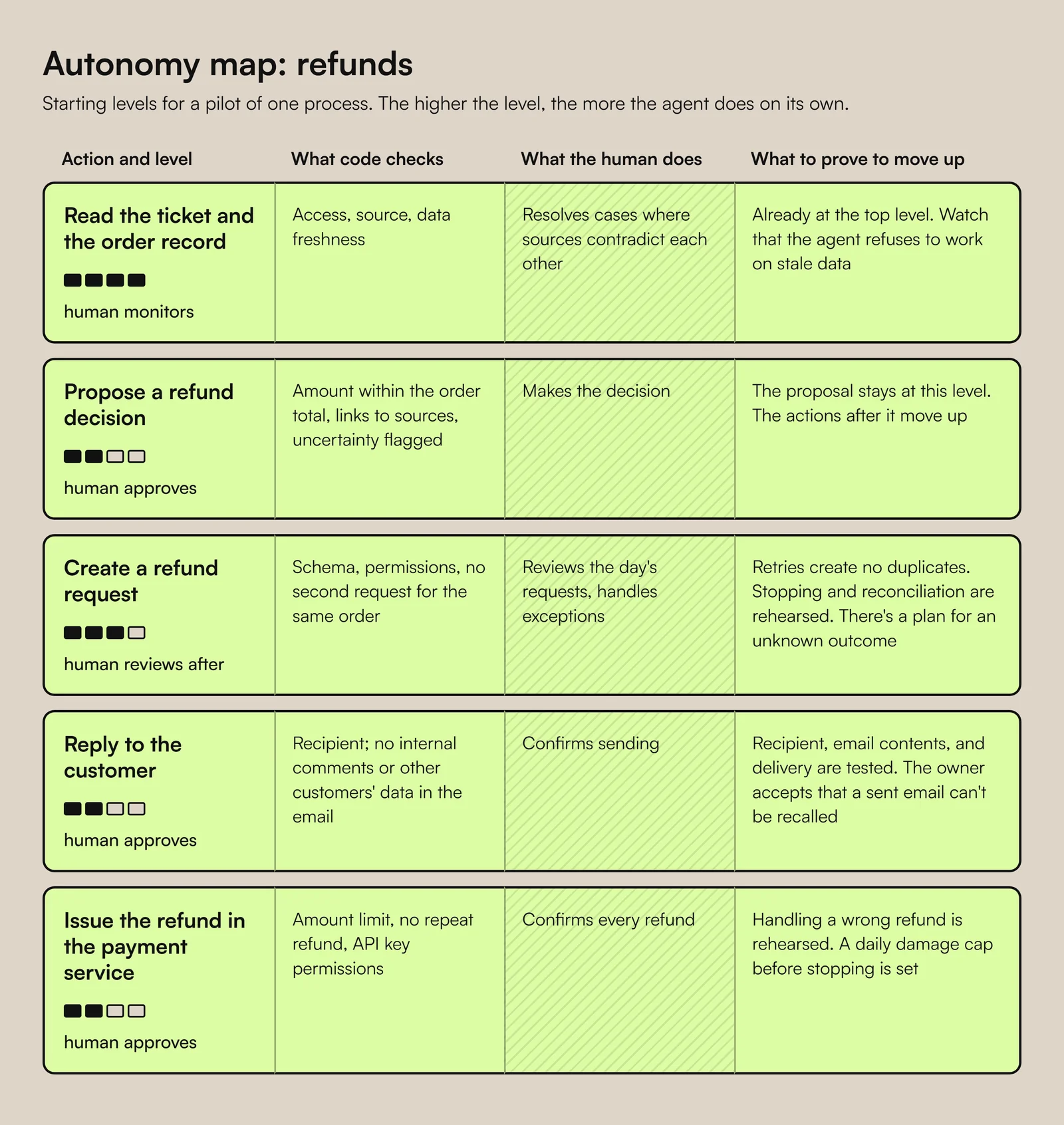
Only one of the five actions starts at the top level: reading. Everything that changes data or reaches the customer starts lower and has to earn its way up.
These are starting levels for a limited launch of one process. Another process will have different values.
If a process includes deletion, deletion starts at "human does"; it can move up to "human reviews after" only if it can be undone, and only after recovery has been rehearsed.
The main thing a map gives you: the team stops debating the agent as a whole and sees the exact place where an external effect appears.
Autonomy is the right to act within a process. It is granted to a single action, together with limits, monitoring, and a way to take that right back. A team that keeps some actions at "human approves" but knows the owner, the log, and the rollback for each of them gets more out of its agent than a team with a formally autonomous agent and none of the above.
A good map shows where the next step is justified and where a human is still needed as part of the architecture.
If you're choosing the first process for an agent, start with three things: name the action, describe the worst outcome, and decide what will prove the action is ready for the next level. Choose the model and the tools after that.
If you're deciding what to entrust to an AI agent in your own process, write to Imaga. We'll break the process down into actions together with your team and help you bring the actions where it's justified all the way to running without a human.
GenAi case studies
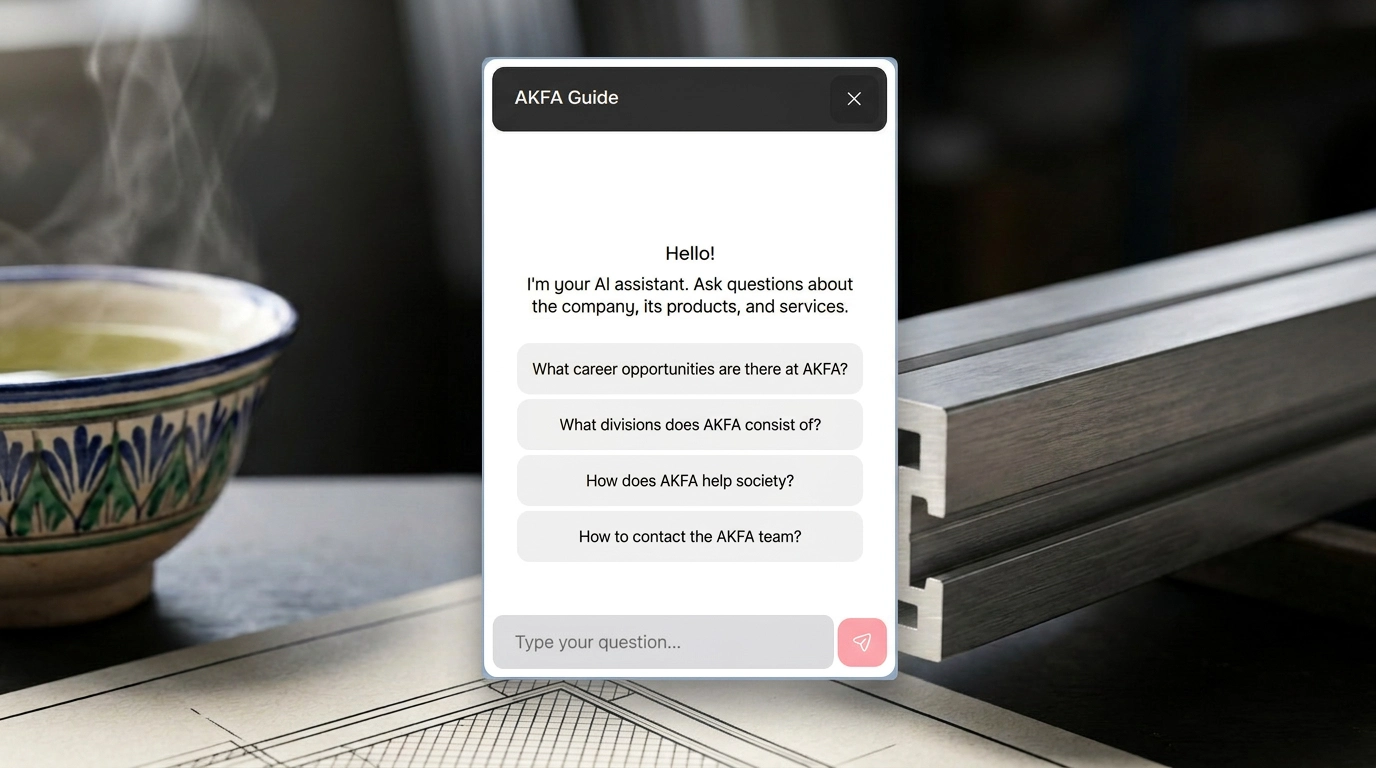
Self-Hosted RAG Chatbot for AKFA Holding

Designing an AI-Powered Journaling App for Daily Reflection and Personal Insights

Scientific Trial PDFs Extraction

SMM Content Automation with AI

17–22 PM Hours Saved per Project With AI Workflows

From a Month of Production to a 2-Minute Draft: AI Case Study Pipeline